How to Cook in a Shared Dorm Kitchen When Everyone Has Different Dietary Needs
Quick Answer: The most workable system for a dorm kitchen with mixed dietary needs is building meals around a shared ‘safe base’ (a protein or grain everyone can eat) and letting each person customize their own portion with individual toppings or add-ins, combined with clearly labeled separate storage for allergen ingredients (like a dedicated gluten-free shelf) to prevent cross-contamination — trying to cook one identical meal that satisfies every restriction usually fails, while a build-your-own structure accommodates everyone without extra cooking.
The key shift is stopping the search for one meal everyone eats identically and instead building a flexible base that each person finishes according to their own needs.
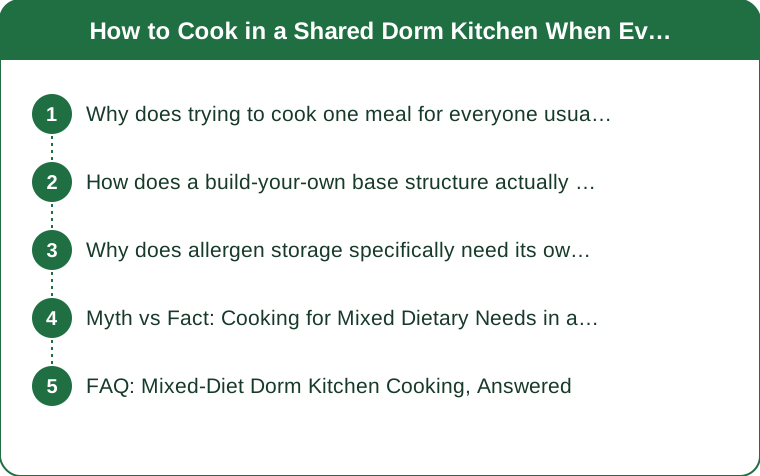
Why does trying to cook one meal for everyone usually fall apart in a mixed-diet household?
Trying to satisfy multiple different restrictions (vegetarian, gluten-free, allergies) within a single fixed recipe usually means either compromising the meal significantly for everyone or ending up cooking multiple separate versions anyway, which defeats the efficiency of cooking together in the first place.
How does a build-your-own base structure actually solve this?
A shared base — rice, a simple protein, roasted vegetables — that’s naturally free of most common restrictions, combined with individual toppings or sauces added after the base is cooked, lets each person customize without requiring separate full recipes, which is far more time and resource efficient in a small shared kitchen.

Why does allergen storage specifically need its own system?
Cross-contamination risk (gluten traces on a shared cutting board, for example) is a real concern for people with allergies or sensitivities, so a clearly labeled, physically separate storage area for allergen-free ingredients and dedicated prep tools for that person meaningfully reduces the risk compared to shared everything.
Myth vs Fact: Cooking for Mixed Dietary Needs in a Dorm
Myth: Accommodating multiple diets in a shared kitchen always means more cooking work overall. Fact: A build-your-own base system often means less total cooking than making separate meals for each restriction.
Myth: Shared cooking only works if everyone has identical dietary needs. Fact: A flexible base-plus-customization structure works well even with several different restrictions in the same household.
FAQ: Mixed-Diet Dorm Kitchen Cooking, Answered
Is it reasonable to ask roommates to split grocery costs differently based on dietary needs?
This varies by household, but many roommates find it simplest to buy shared base ingredients together and individual specialty items (gluten-free items, for example) separately.
How should cooking equipment be handled for someone with a serious allergy?
Dedicated tools (a separate cutting board, toaster, or pan) specifically for that person’s allergen-free food is the most reliable way to prevent cross-contamination in a shared kitchen.
What’s a good starter ‘safe base’ meal to try this system with?
A rice or quinoa bowl with a simple roasted vegetable and protein base, topped individually with sauces, cheese, or extras, is one of the easiest starting points for most mixed-diet households.
TL;DR:
- Trying to cook one identical meal for every dietary restriction usually backfires or doubles the work
- A shared base meal with individual customization solves multiple restrictions without separate recipes
- Dedicated, clearly labeled storage and tools reduce cross-contamination risk for allergies specifically
- A rice-or-grain bowl with individually added toppings is an easy system to start with
A flexible build-your-own approach, not a single universal recipe, is what actually makes cooking for mixed dietary needs work in a small shared dorm kitchen.
Keep Reading
This article is for general informational purposes only and is not medical advice. Always consult a qualified health professional for guidance specific to you.