5 Dorm Meals for the Week Your Meal Plan Runs Out
Quick Answer: Build around three cheap staples that keep without a fridge - rice or instant grains, tinned beans or lentils, and eggs - then add one flavour item that makes each meal taste deliberate rather than desperate. Each of the five below costs roughly the price of a coffee, needs one appliance at most, and delivers real protein. Buy the staples once at the start of the week and the five meals assemble in ten minutes each.
The swipes ran out on a Tuesday and there are nine days left in the month.
These five are built for exactly that week: cheap, filling, mostly shelf-stable, and none of them require more than one appliance or one pan.

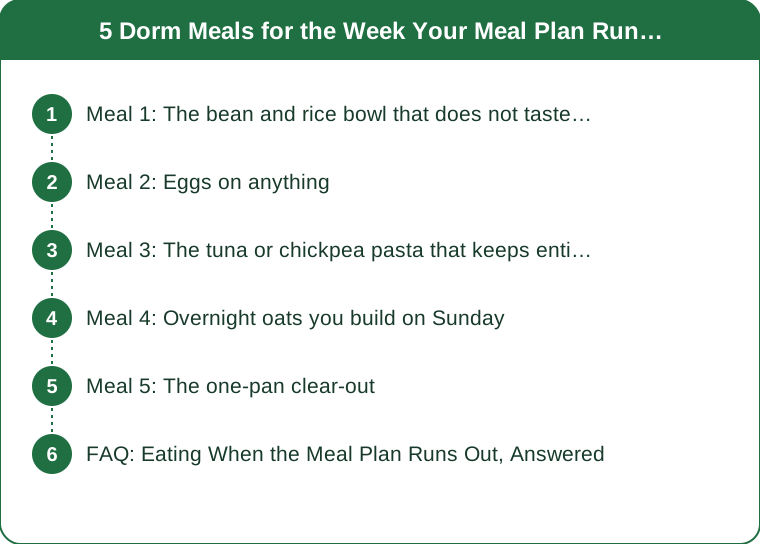
Meal 1: The bean and rice bowl that does not taste like a bean and rice bowl
What it is: microwave rice or instant grains, a tin of black beans, and one strong flavour element - salsa, hot sauce, or a spoon of pesto - plus anything green you have.
Why it works: rice and beans together provide a genuinely complete protein and it costs very little per serving. The flavour item is what separates this from something you resent eating, and it is the one thing worth spending on.
How to build it: heat the rice, drain and rinse the beans, combine in a bowl and microwave for another minute. Stir the flavour item through at the end rather than cooking it, which keeps it tasting fresh.
Upgrade it: a fried or microwaved egg on top, a handful of spinach wilted into the hot rice, or crushed tortilla chips for texture. Any one of the three changes it considerably.
Cost and time: roughly three to four minutes and less than most single coffees. Make double and eat the second portion cold the next day with extra hot sauce.
Watch out for: unrinsed beans, which make the whole bowl taste of tin. Thirty seconds under a tap is the difference.
Meal 2: Eggs on anything
What it is: two or three eggs, cooked however your appliances allow, on toast, on rice, on instant noodles, or on a wrap.
Why it works: eggs are among the cheapest complete protein sources available, they keep for weeks in a fridge, and they cook in a microwave, a pan, or a kettle-boiled mug. The versatility is what makes them the backbone of a low-budget week.
How to build it: for a microwave, beat two eggs in a greased mug with a splash of water and microwave in 30-second bursts, stirring between, for about 90 seconds total. For a pan, low heat and patience beats high heat and speed.
Upgrade it: anything acidic or sharp - hot sauce, a squeeze of lemon, pickles, or a scrape of mustard. Eggs taste flat without something bright alongside.
Cost and time: under two minutes and pennies per serving. It is the fastest thing on this list and the one you will return to most.
Watch out for: microwaving eggs in their shell, which is genuinely dangerous, and overcooking, which is what makes people think they dislike microwave eggs.
Meal 3: The tuna or chickpea pasta that keeps entirely in a cupboard
What it is: dried pasta, one tin of tuna or chickpeas, olive oil, and whatever seasoning you own. Nothing in it needs refrigeration until it is opened.
Why it works: it is the cheapest hot meal per gram of protein you can make with no fridge access, and every component keeps for months. It is also the meal you can build entirely from a single supermarket trip at the start of a hard week.
How to build it: cook the pasta, reserve a splash of the cooking water, then stir the drained tin through with oil, the reserved water, and seasoning. The starchy water is what makes it taste like a sauce instead of a mixture.
Upgrade it: frozen peas thrown in for the last two minutes of the pasta, lemon zest, chilli flakes, or a handful of grated cheese if you have it.
Cost and time: twelve minutes, mostly waiting. Doubles happily and is good cold as a lunch the next day.
Watch out for: draining every drop of pasta water. That splash is doing the work that a sauce would.

Meal 4: Overnight oats you build on Sunday
What it is: oats, milk or a plant alternative, and something sweet, made in five jars or takeaway containers at once and eaten across the week.
Why it works: it removes breakfast decisions from five mornings, costs very little per portion, and needs no cooking at all - only a fridge shelf. On a week when everything else is improvised, having one meal a day already decided is worth more than the calories.
How to build it: roughly equal parts oats and liquid in each container, a spoon of peanut butter or jam, and a pinch of salt. Leave overnight. That is the entire method.
Upgrade it: frozen berries added the night before thaw perfectly and cost a fraction of fresh. A spoon of protein powder if you have it turns it into a genuinely substantial meal.
Cost and time: ten minutes once for five breakfasts. It is the best time-to-benefit ratio on the list.
Watch out for: making all five the same flavour. By Thursday you will not eat it. Vary two of the five even slightly.
Meal 5: The one-pan clear-out
What it is: whatever is left - half an onion, a tired pepper, the end of a bag of rice, a tin of tomatoes - cooked together in one pan with a strong seasoning.
Why it works: the end of a tight week is when food gets wasted, and one dish designed to absorb odds and ends prevents that. It is also the meal that teaches you to cook without a recipe, which is worth more than any single dish.
How to build it: aromatics first if you have them, then the hard vegetables, then the tin, then the grain or pasta, then a lid and time. Season at the end and taste before you serve.
Upgrade it: a tin of beans for protein and bulk, and something acidic at the very end - vinegar, lemon, or pickle juice - which lifts everything.
Cost and time: twenty minutes and, ideally, nothing new bought at all.
Watch out for: the shared-kitchen rules. One pan is easy to clean immediately, and immediately is the only time that counts in a shared kitchen.
FAQ: Eating When the Meal Plan Runs Out, Answered
What are the cheapest filling foods for a dorm?
Rice, oats, dried pasta, tinned beans and lentils, eggs, frozen vegetables, and peanut butter. They keep well, cost little per serving, and combine into most of the meals above.
How do I get enough protein on a tight budget?
Eggs, tinned beans, tinned fish, and lentils are the cheapest reliable sources. Pairing grains with beans gives you a complete protein for very little money.
What if I only have a microwave?
All five above work with a microwave except the one-pan clear-out. Microwave rice, mug eggs, overnight oats, and tinned protein cover a full week without a hob.
How do I stop it getting boring?
Spend on flavour rather than on ingredients - hot sauce, a jar of pesto, spice mixes, and something acidic. Cheap staples plus one strong flavour item is what makes repetitive eating tolerable.
TL;DR:
- Build the week around rice or oats, tinned beans or lentils, and eggs - cheap, shelf-stable, and genuinely filling.
- Spend your limited money on flavour items rather than on ingredients: hot sauce, pesto, spices, something acidic.
- Rice and beans together make a complete protein for very little; eggs are the fastest and cheapest protein you can cook anywhere.
- Overnight oats made once on a Sunday remove five breakfast decisions for about ten minutes of effort.
- End the week with a one-pan clear-out so nothing bought at the start gets wasted.
A week without swipes is a logistics problem, not a hunger problem. Buy the staples once and the rest is assembly.
Keep Reading
This article is for general informational purposes only and is not medical advice. Always consult a qualified health professional for guidance specific to you.