Dorm Kitchen: Five Late Night Study Snacks That Are Not Junk
Quick Answer: The problem with most late-night study food is not calories - it is that pure refined carbohydrate spikes and drops blood sugar within about 40 minutes, right in the middle of the thing you were trying to concentrate on. Every setup below pairs a carbohydrate with protein or fat, which flattens that curve. All five need no oven, minimal cleanup, and under five minutes.
It is 10:40pm, you have two hours of reading left, and the vending machine is closer than the dining hall.

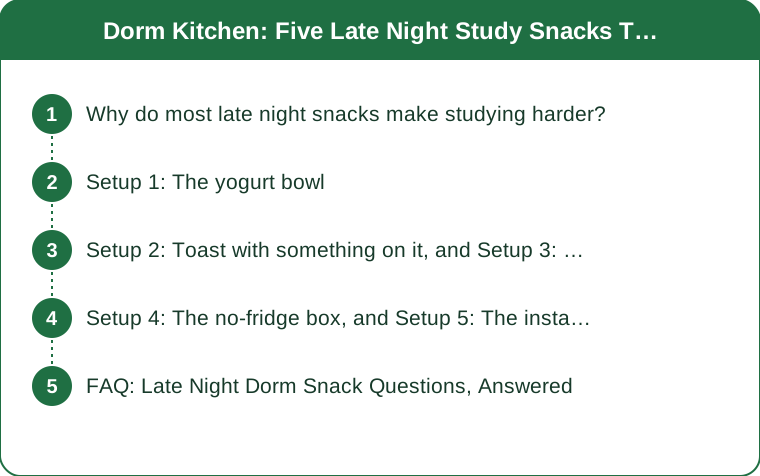
Why do most late night snacks make studying harder?
Because of what happens in the hour after, not the moment you eat them.
Refined carbs alone create a spike and a crash. Chips, cookies, dry cereal, and instant noodles digest fast, raise blood sugar quickly, and drop it just as fast. The crash typically lands 30 to 60 minutes later and feels exactly like the fatigue you were snacking to fix.
Protein and fat flatten the curve. Adding either slows digestion, which turns a spike into a gradual rise. This is the single principle behind every setup below - not a specific food, but a pairing.
Volume matters for comfort. A heavy snack close to bed makes falling asleep harder and can cause reflux if you lie down soon after. Aim for something in the 200 to 350 calorie range, not a meal.
Caffeine after 4pm is doing more damage than the food. Caffeine has a half-life of roughly five to six hours, so a 9pm energy drink is still meaningfully active at 2am. If late-night focus is the goal, the snack is the smaller lever.
Setup 1: The yogurt bowl
The most reliable one, and the easiest to keep stocked in a shared fridge.
What you need: a single-serve Greek yogurt, any nut butter, and something crunchy - granola, a chopped nut, or a broken-up cracker.
How it works: Greek yogurt provides 15 to 20 grams of protein per container, which is more than most dorm meals deliver in a single item. The nut butter adds fat, the crunch adds texture, and the whole thing takes about 90 seconds.
Why it beats the alternatives: it needs no cooking, no shared pan, no cleanup beyond a spoon, and it does not smell - which matters enormously at 11pm in a building with thin walls and a roommate who went to bed at ten.
Making it better: frozen berries stirred in thaw within a couple of minutes and add fiber and water content, both of which increase how full it leaves you. A drizzle of honey is fine and does not undo the pairing, since the protein is doing the work.
Fridge reality check: yogurt is one of the few genuinely good uses of scarce shared fridge space, because it is a complete snack rather than an ingredient. Label it with your name and the date.

Setup 2: Toast with something on it, and Setup 3: The microwave egg
Setup 2: Toast that actually holds. Whole grain bread plus nut butter plus sliced banana, or plus cottage cheese and cracked pepper if you prefer savory. Two minutes, one plate.
The upgrade over plain toast is entirely the topping. Bread alone is the classic spike-and-crash, while bread with 8 to 10 grams of protein on it behaves completely differently. Cottage cheese is the underrated option here - high protein, cheap, and it keeps well.
Setup 3: The microwave egg. One egg beaten in a mug with a splash of milk, microwaved in 20 to 30 second bursts, stirring between. Ninety seconds total.
This is the highest-protein setup on the list for the money, and it is genuinely filling. Add cheese, salsa, or spinach if you have them. Cook in short bursts rather than one long one - a mug egg goes from soft to rubbery in about ten seconds, and it can pop if overcooked.
One etiquette note: microwaving egg late at night is smellier than the other options. If your microwave is in a shared lounge, this is a 9pm snack rather than a midnight one.
Setup 4: The no-fridge box, and Setup 5: The instant noodle fix
Setup 4: The shelf-stable box. For the nights you cannot leave the room, or the fridge is full. Roasted chickpeas or mixed nuts, whole grain crackers, and a shelf-stable protein - a tuna packet, jerky, or a protein bar with at least 10 grams of protein and under 15 grams of sugar.
Keep this box assembled in a drawer, permanently. The entire value is that it requires no decisions at midnight, which is when decision-making is at its worst. Restock it on the weekend like any other supply.
Setup 5: Rescuing instant noodles. You are going to eat them anyway, so make them work. Crack an egg into the hot broth and stir - it cooks in the residual heat in about a minute. Add frozen peas or spinach, and use only half the seasoning packet.
The egg is the whole intervention. Plain instant noodles are close to pure refined carbohydrate with a large sodium load. With an egg and vegetables they become a legitimate small meal, and the crash largely disappears.
Half the packet matters too: a full seasoning packet frequently carries over 1,500mg of sodium, and using half changes almost nothing about the taste.
FAQ: Late Night Dorm Snack Questions, Answered
Is eating late at night actually bad?
Eating late is not inherently a problem. What causes trouble is eating a large or very rich meal shortly before lying down, which affects sleep quality and can cause reflux. A moderate snack an hour before bed is fine for most people.
What if I have no fridge access at all?
Setup 4 is built for exactly that, and it works indefinitely. Nut butter packets, shelf-stable milk, tuna packets, and roasted chickpeas cover protein without refrigeration.
How do I stop my food from disappearing in a shared fridge?
Label with name and date, use an opaque container, and keep the snacks that matter most in your own room where they do not need cold storage. It is not a food safety solution but it is a practical one.
Does any of this help me stay awake?
Steady blood sugar prevents the crash that makes you feel like you cannot continue. It will not substitute for sleep, and no snack does. If you are consistently studying past midnight, the schedule is the real problem and the snack is a patch.
This is general information, not medical advice.
TL;DR:
- The crash matters more than the calories - refined carbs alone drop you 30 to 60 minutes after eating.
- Pair every carbohydrate with protein or fat, and keep the whole thing in the 200 to 350 calorie range.
- Five setups: yogurt bowl, loaded toast, microwave mug egg, a shelf-stable box you assemble in advance, and instant noodles rescued with an egg.
- Caffeine after 4pm undermines you more than any snack does, since it is still active five to six hours later.
The box in the drawer is the one worth setting up this week. Every other setup requires you to make a reasonable decision at 11:40pm, and the whole reason the vending machine wins is that it requires none at all.
Keep Reading
This article is for general informational purposes only and is not medical advice. Always consult a qualified health professional for guidance specific to you.