5 Dorm Breakfasts You Can Actually Make in Under 4 Minutes
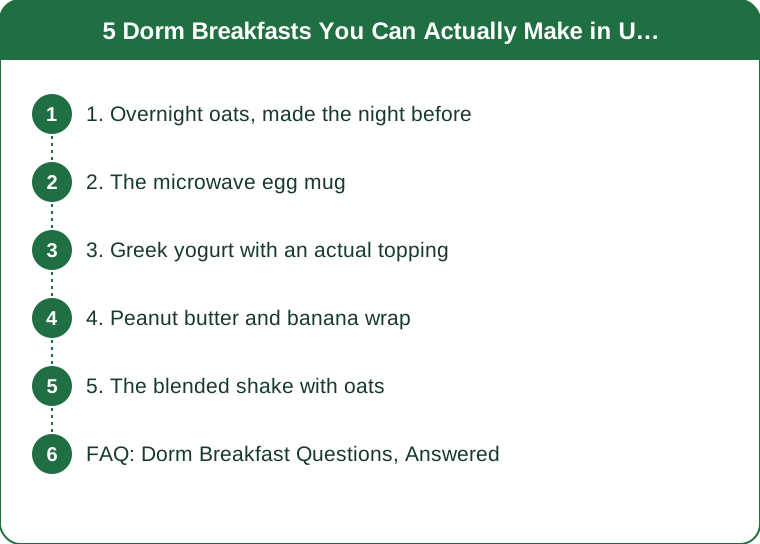
Quick Answer: The five that work with dorm equipment are overnight oats made the night before, a microwave egg mug, Greek yogurt with a real topping, a peanut butter and banana wrap, and a protein shake with oats blended in. Each hits at least 15 grams of protein, takes under four minutes of active time, and needs nothing more than a microwave, a kettle, or a fridge.
The reason most students skip breakfast is not appetite. It is that every option requires either cooking or a decision at 8:15am.

1. Overnight oats, made the night before
The only one requiring advance work, and the one most likely to actually get eaten, because morning effort is zero.
The build: half a cup of rolled oats, half a cup of milk or a milk alternative, a heaped spoon of Greek yogurt, and a spoon of chia seeds if you have them. Stir, cover, fridge. In the morning: add fruit and eat.
Why it works nutritionally: oats provide roughly 4 grams of fiber per half cup dry, largely beta-glucan, which is the viscous soluble fiber that slows gastric emptying. Add yogurt and milk and you are at 15 to 20 grams of protein. That combination holds most people through a morning of classes.
Practical notes: it keeps 3 to 4 days in the fridge, so making four jars on Sunday night is genuinely realistic. Use jars or containers with lids that seal, because a dorm fridge is not a stable environment.
The upgrade: a scoop of protein powder stirred in takes it to 35 grams of protein and costs about 20 seconds. If you only make one change to this list, that is the one.
Active morning time: under 30 seconds.
2. The microwave egg mug
Two minutes, one mug, and it is a genuinely hot breakfast.
The build: crack two eggs into a large mug, add a splash of milk, whisk with a fork, microwave for 45 seconds. Stir. Microwave 30 to 45 seconds more. Add cheese, salt, and whatever vegetable you have.
Why it works: two eggs are about 12 grams of complete protein plus choline, and the fat content contributes to satiety. Adding cheese or a handful of spinach makes it a real meal.
The technique that matters: cook in two short bursts with a stir between, not one long one. Eggs go from underdone to rubbery very quickly, and the stir distributes the heat. Use a mug at least twice the volume of the raw egg, because it puffs dramatically and overflowing egg in a shared microwave is a memorable social error.
Practical notes: a wide mug cooks more evenly than a tall one. Grease it lightly or cleanup is unpleasant.
Active time: about 3 minutes, most of it waiting.
3. Greek yogurt with an actual topping
The lowest-effort option on the list, and the one most often done badly.
The build: a cup of plain Greek yogurt, a handful of nuts or granola, fruit, and a drizzle of honey.
Why plain matters: flavored yogurts commonly carry 15 to 25 grams of added sugar per serving, which is most of the daily recommended limit before 9am. Plain Greek yogurt has about 15 to 20 grams of protein per cup and essentially no added sugar. Sweetening it yourself with honey or fruit costs a fraction of that.
Why the topping is not optional: yogurt alone is protein and very little else. The nuts add fat and texture, the fruit adds fiber, and the combination is what makes it hold. Yogurt alone tends to leave people hungry by 10.
Practical notes: buy the large tub rather than individual pots - substantially cheaper per serving and less packaging in a small bin. Keep a bag of nuts in your desk drawer rather than the fridge, so half the meal does not depend on the fridge working.
Active time: under 60 seconds.

4. Peanut butter and banana wrap
The one you can eat while walking, which matters more than it sounds.
The build: a wholegrain tortilla, two tablespoons of peanut butter, a sliced banana, roll it up.
Why it works: two tablespoons of peanut butter is about 7 to 8 grams of protein and 16 grams of fat, which is the slow-digesting component. The banana adds roughly 3 grams of fiber and readily available carbohydrate. A wholegrain tortilla adds 3 to 5 grams of fiber.
Total: around 12 grams of protein, 8 grams of fiber, and about 450 calories - which is a genuine breakfast rather than a snack.
The upgrade: swap in a high-protein tortilla, which are widely available and add 5 to 10 grams. That brings it to roughly 20 grams of protein for no additional effort.
Practical notes: nothing needs refrigeration except optionally the peanut butter, which makes this the most reliable option when the dorm fridge is full or has failed. Wrap it in foil and it survives a backpack for a couple of hours.
Active time: about 90 seconds.
5. The blended shake with oats
For the mornings where four minutes is genuinely not available.
The build: a scoop of protein powder, half a cup of rolled oats, a banana, a cup of milk. Blend if you have a small blender or a shaker bottle with a mixing ball - oats blend better than they shake, but shaking works with quick oats.
Why it works: this hits 30 to 35 grams of protein and 6 to 8 grams of fiber in one container, which is more than most sit-down breakfasts.
Why the oats matter: a protein shake alone empties from the stomach quickly and leaves people hungry within an hour or two. Adding oats brings the fiber and the slower carbohydrate that makes it hold. This is the single difference between a shake that works as breakfast and one that does not.
Practical notes: a personal blender is one of the more genuinely useful dorm purchases if it is allowed. Without one, use quick oats and shake vigorously - the texture is grainier but the nutrition is identical.
Active time: about 2 minutes including washing the bottle, which you should do immediately rather than discovering it three days later.
FAQ: Dorm Breakfast Questions, Answered
What if I do not have a fridge at all?
The wrap and the shake work with shelf-stable ingredients - shelf-stable milk cartons, peanut butter, tortillas, protein powder, and bananas all keep at room temperature. That covers two of the five with no fridge dependency.
Is skipping breakfast actually a problem?
Not inherently - what matters is total daily intake. But if you are getting to an 11am class unable to concentrate, that is a signal worth responding to, and morning protein specifically tends to reduce afternoon overeating.
How do I keep the cost down?
Buy the large containers - a tub of yogurt, a canister of oats, a jar of peanut butter - rather than single servings. The per-serving cost of these five is typically well under half what a campus cafe charges, which adds up substantially over a semester.
TL;DR:
- Overnight oats need 30 seconds in the morning and keep 3 to 4 days - the most reliable option on the list.
- The microwave egg mug takes 3 minutes; cook in two bursts with a stir, in a mug twice the volume of the eggs.
- Plain Greek yogurt plus a real topping beats flavored yogurt, which often carries 15 to 25 grams of added sugar.
- The peanut butter wrap needs no refrigeration and survives a backpack.
- A shake only works as breakfast if you add oats - protein alone empties too fast.
All five hit at least 12 to 15 grams of protein, which is the number that determines whether you make it to lunch.
Keep Reading
This article is for general informational purposes only and is not medical advice. Always consult a qualified health professional for guidance specific to you.