5 Ten-Minute Dorm Breakfasts That Survive an 8am Class
Quick Answer: Build breakfasts around three things a dorm reliably provides: a kettle or microwave, shelf-stable staples, and something prepared the night before. The five setups below each take under ten minutes of active time, need no oven or stovetop, and hold up to a shared fridge. Each includes a protein, because a carbohydrate-only breakfast is the reason you are hungry in your second class.
The habit that makes all five work: doing two minutes of setup the night before.

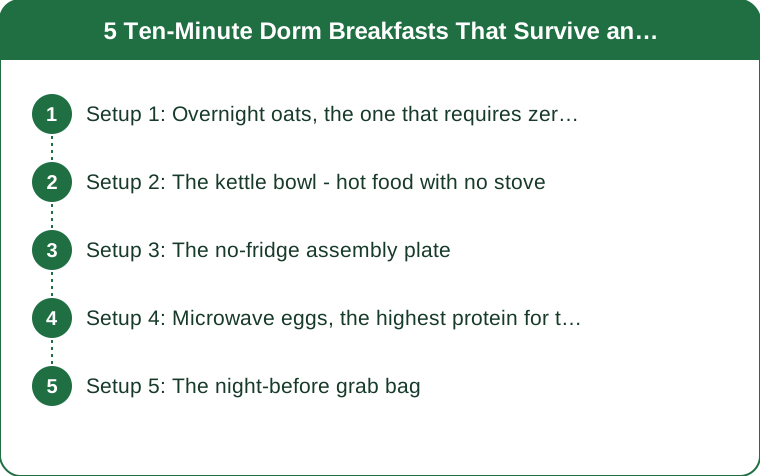
Setup 1: Overnight oats, the one that requires zero morning time
The only breakfast on this list that takes literally no morning effort, which is why it belongs first.
The base ratio. Equal parts rolled oats and liquid, by volume. Half a cup of each is a solid single portion, and it scales linearly.
The assembly, 2 minutes the night before:
- Half a cup of rolled oats into a jar or any container with a lid
- Half a cup of milk or fortified plant milk
- A tablespoon of chia seeds, which is what makes the texture thick rather than soggy
- A pinch of salt, which matters more than people expect
- Lid on, into the fridge
The protein problem and its fix. Oats and milk give you roughly 10 to 12g of protein, which is low for a breakfast. Add a scoop of protein powder, a spoonful of Greek yogurt, or two tablespoons of peanut butter to bring it to a level that holds until lunch.
Five variations from the same base:
- Peanut butter and banana - stir peanut butter in at night, slice banana in the morning
- Berries and yogurt - frozen berries work and thaw overnight
- Apple and cinnamon - grated apple, cinnamon, a spoon of honey
- Chocolate - a spoon of cocoa powder and a chopped date
- Coffee - replace a quarter of the milk with cold brew
Why it survives a dorm. No cooking, no equipment, and it keeps 3 to 4 days refrigerated, so you can make three at once on a Sunday evening. It also travels, which means it works as a breakfast eaten in the lecture hall when the morning goes badly.
The one thing to get right: use rolled oats, not instant and not steel-cut. Instant turns to paste, steel-cut stays hard.
Setup 2: The kettle bowl - hot food with no stove
A kettle plus a bowl covers more hot breakfasts than most people realize, and a kettle is permitted in far more dorms than a hot plate.
The method. Boil water, pour over ingredients in a bowl, cover with a plate for 3 to 5 minutes.
What it makes:
- Instant oats with additions - a sachet plus a spoon of nut butter and a handful of frozen berries turns a thin base into a real meal
- Couscous savory bowl - couscous rehydrates in 5 minutes with boiling water. Add a stock cube, tinned chickpeas and any vegetable
- Instant noodles upgraded - add an egg. Crack an egg into the bowl before pouring boiling water and stir vigorously; it cooks into ribbons and adds 6g of protein
- Grits or polenta, which rehydrate the same way
Why the covered bowl matters. Trapping the steam is what does the cooking. An uncovered bowl loses heat too fast and leaves you with crunchy couscous, which is the single most common failure.
The dorm-specific advantages:
- A kettle is usually allowed where hot plates are not, and it is the single most useful appliance in a dorm room
- No pan to wash, which in a shared kitchen is a genuine constraint rather than a minor one
- All ingredients are shelf-stable, so nothing depends on the shared fridge
A note on food safety. Boiling water is roughly 100C and drops fast once poured. This method rehydrates; it does not cook raw meat. Egg stirred into boiling water in a covered bowl works because of the volume ratio and the small size of the pieces - do not extend the technique to anything larger.

Setup 3: The no-fridge assembly plate
For anyone whose shared fridge is unreliable, full, or a source of ongoing conflict.
The concept. A breakfast built entirely from shelf-stable items that lives in your room, not in a communal space.
The components:
- Protein: nut butter, tinned fish, shelf-stable protein shakes, roasted chickpeas, jerky, nuts
- Carbohydrate: whole grain crackers, bread that keeps, oatcakes, tortillas
- Produce: whole fruit that does not need refrigeration - apples, oranges, bananas. Dried fruit as backup
- Fat and flavor: honey, jam, hummus in single-serve pots, olive oil
Three assemblies that take four minutes:
- Nut butter on wholegrain toast with banana and a drizzle of honey - roughly 15g protein with a good nut butter
- Tortilla with hummus, tinned tuna and cucumber, rolled - savory, filling, and no cooking
- Oatcakes with nut butter plus an apple and a handful of nuts - the fastest option here, and entirely portable
Why this matters more than it sounds. Shared dorm fridges are the site of most food conflict and most food loss. Building at least one breakfast option that does not depend on the fridge at all means you always have a fallback when your yogurt has disappeared or the fridge has failed.
Storage in a dorm room:
- Airtight containers, without exception. Open packets attract insects and mice, and this is not a theoretical concern in student housing
- Off the floor and out of direct sun, which shortens shelf life considerably
- Check dates on nut butters and oils - they do go rancid, and rancid nut butter tastes obviously wrong
Setup 4: Microwave eggs, the highest protein for the time
Eggs in a mug take 90 seconds and deliver more protein per minute of effort than anything else on this list.
The method:
- Two eggs into a large microwave-safe mug, beaten with a fork
- A splash of milk, which makes the texture softer
- Microwave 45 seconds, stir, then 30 to 45 seconds more. Stirring midway is what prevents rubbery eggs
- Use a mug much larger than you think you need. Eggs expand dramatically and overflow is the standard first-attempt outcome
Additions that need no preparation:
- Pre-shredded cheese
- Chopped ham or leftover meat
- Frozen chopped spinach, straight from frozen
- Hot sauce, which improves the result substantially
- Salsa, which adds moisture and flavor with no chopping
Why eggs are worth the effort. Two eggs provide roughly 12 to 14g of high-quality protein for about 140 calories. On a student budget they are one of the cheapest protein sources available, and they keep 3 to 5 weeks refrigerated.
Making it a full breakfast:
- Eggs plus toast plus fruit takes about six minutes total and covers all four components
- Or eggs into a tortilla with cheese and salsa, which is portable and eats in one hand
On the shared microwave. It is often occupied at peak times. The workaround is a slightly earlier or later start, or having Setup 1 or 3 as the fallback for microwave-queue mornings. Having two options is what stops the whole plan collapsing on a busy Tuesday.
Setup 5: The night-before grab bag
For mornings where ten minutes is not available - which will happen more often than you plan for.
The concept. A complete breakfast assembled the night before and left where you will physically trip over it.
What goes in:
- A protein source that does not need refrigeration for a couple of hours - a shelf-stable shake, a protein bar, a bag of nuts, a hard-boiled egg
- A carbohydrate - a bagel, a banana, an oat bar
- Something to drink, prepared the night before
Combinations that hold up in a bag:
- Hard-boiled egg, wholegrain roll, apple
- Protein shake, banana, small bag of almonds
- Overnight oats jar with a spoon taped to the lid
- Peanut butter sandwich, orange, milk carton
Why this exists as a separate setup. The failure point of every breakfast plan is the morning where you wake up 20 minutes late. Without a grab option, that morning becomes a skipped breakfast, and skipped breakfasts compound - by mid-morning you are buying something expensive and less filling.
Where to leave it. Not in the kitchen. On top of your bag, or directly in front of the door. A grab bag you have to remember is a grab bag you will forget.
The prep habit that makes all five setups work. Two minutes at night, every night: assemble tomorrow’s breakfast or check that the components exist. Attached to brushing your teeth or setting your alarm, it becomes automatic within about two weeks. This single habit is the difference between having a breakfast system and having a list of breakfast ideas.
On the wider point. Eating something with protein in the morning is not a moral requirement, but for an 8am class it changes concentration and reduces the mid-morning crash meaningfully. The goal here is not an impressive breakfast. It is a reliable one.
TL;DR:
- Overnight oats need zero morning time and keep 3 to 4 days - make three at once
- A kettle plus a covered bowl cooks more than you think: couscous, oats, egg-ribbon noodles
- Keep one fridge-free option so a failed or raided shared fridge never means no breakfast
- Microwave mug eggs deliver the most protein per minute; use a bigger mug than seems necessary and stir midway
- Always have a grab bag ready by the door for the mornings that go wrong
Every one of these works because of two minutes of setup the night before. That habit is the actual system.
Keep Reading
This article is for general informational purposes only and is not medical advice. Always consult a qualified health professional for guidance specific to you.