The Roommate Food Treaty: Sharing a Tiny Kitchen Without a Cold War
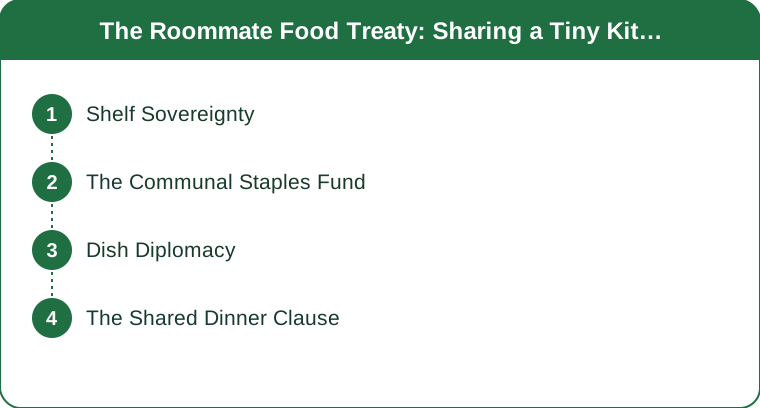
Quick Answer: A roommate kitchen system needs four clauses: defined shelf territory, a shared staples fund (about $5 each per month, one designated buyer), a dish deadline with named consequences, and one optional weekly communal meal. Writing it down in twenty minutes at move-in prevents most of the year’s conflict.
Every shared kitchen sits one eaten yogurt away from a cold war.
The disputes are never really about yogurt. They’re about missing systems — nobody agreed what “shared” meant, so everyone quietly invented their own definition and got offended when the others didn’t match.
Twenty minutes of treaty-writing in September prevents a year of passive-aggressive sticky notes. Here’s the template.

How Do You Split a Shared Fridge Fairly?
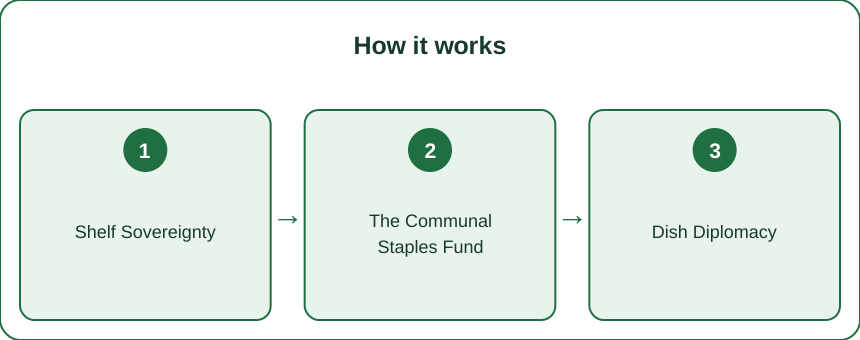
Give each person defined territory: a fridge shelf, a cupboard shelf, a freezer bin, and one drawer.
Then the clause that does the real work: unlabeled items in shared zones are communal by law; labeled items are sacred. No exceptions, no “I assumed.”
Roughly ninety percent of kitchen conflict dies right here, because most food theft is genuinely accidental. Somebody saw an unmarked container in a shared space at 1am and drew the obvious conclusion.
Practical version: a roll of masking tape and a marker live on top of the fridge. Name and date. Takes four seconds.
For a four-person kitchen, rotate the prime real estate — the eye-level shelf, the one that isn’t at the back where things go to die — every semester. It’s a small thing that heads off a specific resentment.
What Should Be a Shared Cost?
Oil, salt, pepper, coffee, sugar, dish soap, sponges, foil, trash bags. The things everyone uses and nobody wants to keep buying alone.
Set up a communal staples fund: roughly $5 per person per month, with one designated buyer who restocks and posts the receipt. Rotate the buyer each semester so it isn’t quietly one person’s unpaid job.
This ends both problems at once — the freeloading resentment and the four-bottles-of-ketchup problem where everyone bought their own because they didn’t trust the system.
Keep the list short and boring. The moment somebody tries to add “oat milk” to shared staples, you’re negotiating brand preferences, and that’s a different treaty.

The Dish Clause (This Is the One With Teeth)
Dishes done by the cook before bed, with a 24-hour hard maximum.
And it needs a named consequence, because a rule without one is a suggestion. The traditional dorm version: after 24 hours, the offending dishes migrate to the offender’s desk. Harsh, effective, and famously memorable.
Sink archaeology destroys more friendships than politics. A sink with three days of dishes doesn’t just look bad — it functionally removes the kitchen from everyone else’s use, which turns a small annoyance into a daily one.
Softer alternative if desk-migration feels aggressive: the 24-hour offender covers the next staples restock. Money is a gentler enforcer than shame, and it works about as well.
Does a Shared Meal Actually Help?
More than you’d expect. One optional communal meal a week — rotating cook, one big cheap pot of chili, pasta or curry — costs each person maybe $3–4 and forty minutes.
What it buys is goodwill, and goodwill is what makes every other clause enforceable. It is much easier to say “hey, your pan’s been in the sink since Tuesday” to someone you ate dinner with on Sunday.
Keep it optional and keep it low-effort. The moment it becomes a scheduled obligation with dietary negotiations, it stops working. Treaties hold better between people who eat together, not between people who resent a standing commitment.
5 Mistakes Everyone Makes in a Shared Kitchen
1. Assuming instead of agreeing. “I thought condiments were shared” is the origin story of most kitchen feuds. Write it down.
2. Waiting for a blow-up to make rules. Rules written during a conflict are read as accusations. Rules written in week one are just admin.
3. Passive-aggressive notes. A sticky note saying whoever keeps using my pan… has never once solved anything. Say it out loud, once, calmly, and then rely on the written clause.
4. Not defining the counter. Everyone thinks about the fridge and forgets the counter, which is the scarcest resource in a tiny kitchen. Clear-by-bedtime applies to counters too.
5. Over-engineering the treaty. A one-page agreement with four clauses gets followed. A twelve-point spreadsheet with a chore rota and a fines schedule gets ignored by week three. Keep it short enough that people remember it without checking.
Mini FAQ
What if one roommate cooks constantly and another never does?
Separate cooking frequency from cleaning duty. The heavy cook uses more of the shared staples and the sink, so a fair trade is: they cook and clean their own, the non-cook takes the shared jobs — trash, floor, restocking runs. Contribution doesn’t have to be identical to be even.
How do we handle a roommate who ignores the treaty?
One direct conversation, in person, naming the specific behavior and the agreed clause. If it repeats, escalate to a house meeting rather than to notes or group chats. In dorms, an RA is a legitimate next step and that’s literally the job.
Should we share cookware too?
Usually yes for pots and pans, no for knives and anything expensive. The rule that works: shared cookware gets washed and returned to its home immediately after use. Anything someone paid real money for stays personal and is borrowed by asking.
TL;DR:
- Define territory; unlabeled in shared space = communal, labeled = untouchable.
- Fund shared staples: ~$5/person/month, one rotating buyer, receipt posted.
- Dishes: cook cleans before bed, 24-hour max, with a named consequence.
- One optional weekly shared pot buys the goodwill that enforces everything else.
- Keep the treaty to one page and write it before the first conflict, not after.
Territories defined, staples funded, dishes deadlined, one shared pot weekly. The tiny kitchen was never the problem — the missing treaty was. Draft it before the first yogurt goes missing.
Keep Reading
This article is for general informational purposes only and is not medical advice. Always consult a qualified health professional for guidance specific to you.